
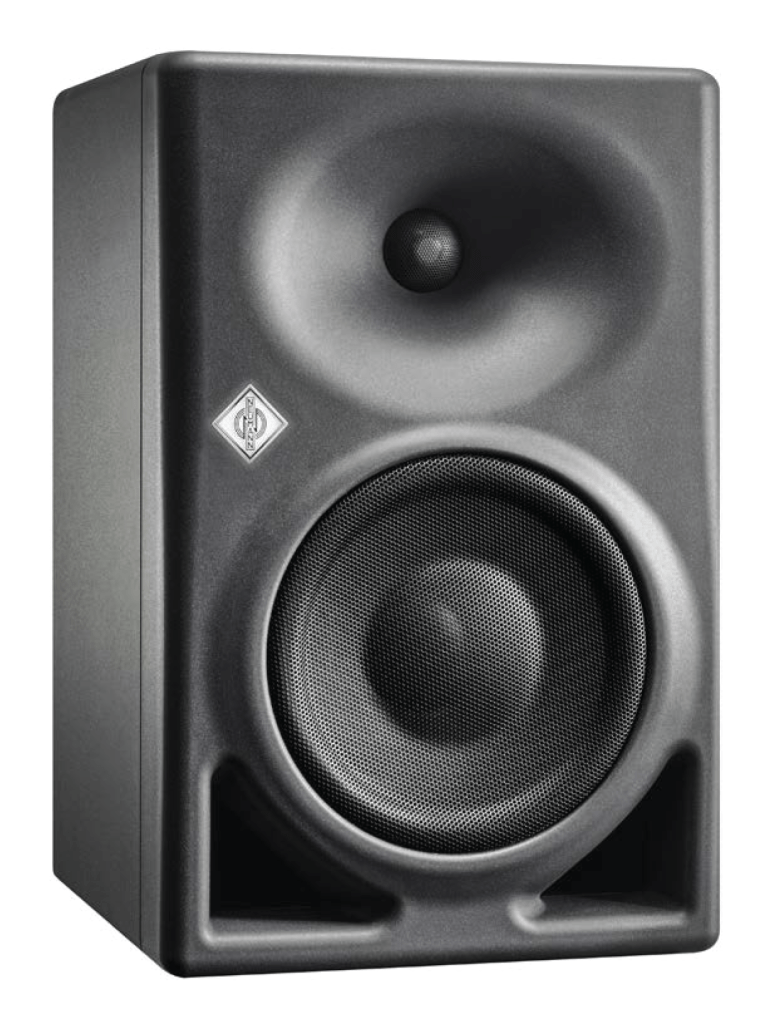
My work reviewing nearfield monitors for Sound On Sound occasionally provokes thoughts that are perhaps a little too far off-piste for the relatively simple needs of a magazine review, and my recent review of the newly introduced Neumann KH150 was prime example. I gave the KH150 a very positive review in the magazine, but having had a few more week’s experience of the monitor (Neumann have kindly let me keep hold of the review samples for a while) and on re-reading the review, I genuinely wonder if I could have been yet more positive: the KH150 really is THAT good. It’s so good that my expectations of the performance achievable from a modestly dimensioned and not unfeasibly expensive active monitor have been somewhat re-calibrated.
But what is it that makes the KH150 work so well? What’s the secret ingredient? This to me is a fascinating question because at first, and even second, glance the KH150 looks a relatively conventional loudspeaker that would be conceptually comprehensible by the very first speaker engineers: Edward Kellog and Chester Rice, who patented what we know know as a moving-coil driver in 1929. By comparison, for example, if you were to show Alexander Graham Bell (who, Wikipedia tells me, “is credited with patenting the first practical telephone”) a contemporary smartphone, he’d not really have the foggiest idea how it works (welcome to the club Alexander). The difference here is that while telephone development has progressed through conceptual leaps: from wired analogue via wireless analogue and wireless digital to wireless IP smartphone, loudspeakers development over its hundred or so years of existence has generally been a process of incremental development.
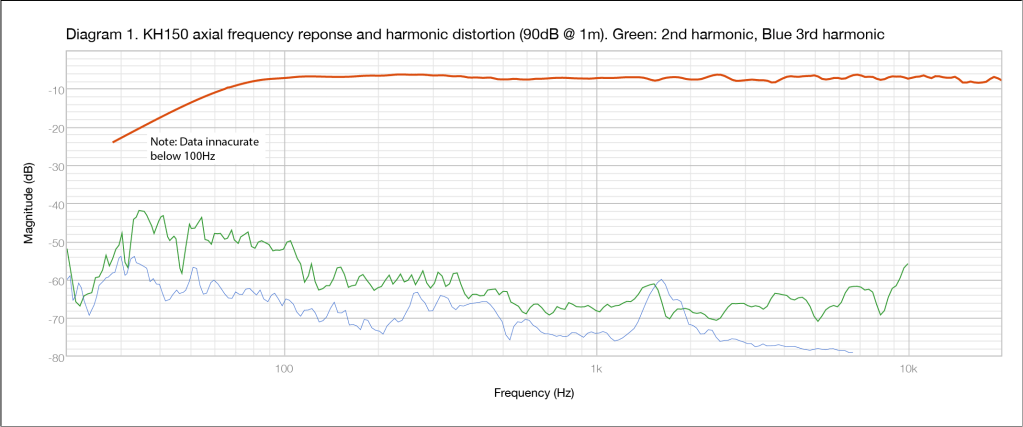
Having said that however, one element of the KH150 (and, it’s fair to say, of other notable contemporary monitors from manufacturers such as Genelec, Kii Audio, PMC, Dutch & Dutch, Dynaudio, ADAM Audio, etc) that would have Edward and Chester scratching their heads is its use of digital signal processing to manage and optimise the inherent electro-acoustics of its drivers and enclosure. DSP equalisation is partly responsible for the KH150s extraordinarily flat axial frequency response (I measured the frequency response as part of my Sound On Sound review and I’ve included the resulting response curve below). But DSP also works more subtly to help the KH150 achieve harmonic distortion numbers that are closer to those of audio electronics than some more traditional loudspeakers. And I strongly suspect that the exceptionally low distortion of the KH150, just as much as its exceptionally flat frequency response, contributes very significantly to its subjective performance.
The KH150 however isn’t just about DSP. It’s a monitor of the DSP age, but it’s also defined by some remarkable electro-acoustic design, in particular within its bass/mid driver. The second fifty-years of driver design have typically been dominated by considerations and developments of diaphragm materials. Conceptually, focussing on diaphragm performance makes intuitive sense: the loudspeaker diaphragm constitutes the final link in the audio reproduction chain and it is well known to be generally compromised. We don’t even, for example, have a diaphragm material that’s rigid and light enough to cover the full audio band without resonance. Consequently, since thermo-plastic diaphragms arrived (driven primarily by BBC research) in the mid 1970s and began to succeed paper (the original diaphragm material), a whole range of options; aluminium, woven fibres (carbon, kevlar, etc.), beryllium, graphene, ceramics, wood, and countless composites and sandwiches, have been tried – some of them with success, but most often, it has to be said, without the fanfare of a major breakthrough.
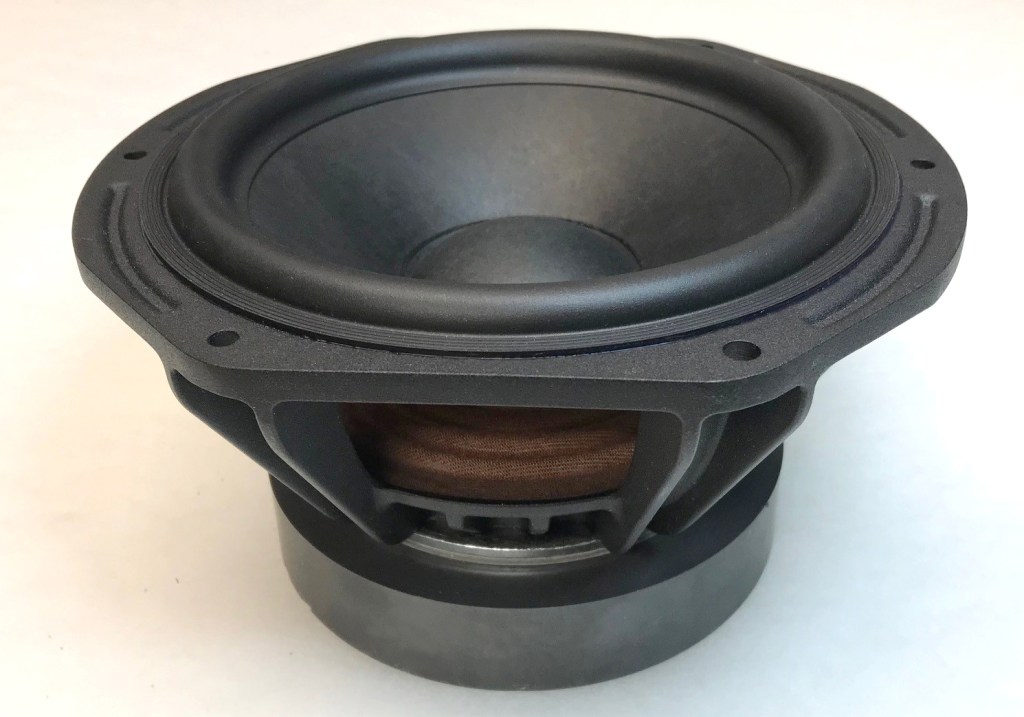
The KH150 bass/mid driver however employs a broadly traditional paper diaphragm (Edward and Chester’s diaphragm was paper too) and that reflects, I think, that in truth the traditionally accepted wisdom of diaphragm material being the primary arbiter of driver performance doesn’t really stand up to much scrutiny. What does increasingly stand up to scrutiny however, to my ears anyway, is that drivers designed with an emphasis on dynamic linearity (by which I mean the ability accurately to follow the input signal) and minimal distortion, offer significant subjective benefits over drivers that prioritise amplitude response linearity and bandwidth. The implication of this for driver design is that the focus moves away from diaphragm material to concentrate on the motor system (magnetic circuit components and voice-coil), roll-surround and suspension, for those locations are where the dynamic and distortion performance of a driver is predominantly defined. And that’s also where the electro-acoustic design effort that resulted in the KH150 bass/mid driver was spent (Bruno Putzey’s remarkable Purifi drivers tread a not dissimilar path). The driver combines extraordinarily low distortion combined with an ability to remain dynamically linear over a huge (in driver terms) ±12mm diaphragm displacement range. And I think it really shows in the way the KH150 performs.
So the secret ingredient of the KH150 isn’t really a secret, and it isn’t any single element. It’s a combination of maximising the bass/mid driver dynamic and distortion performance, and then employing DSP to optimise the system amplitude response. Audio DSP has been around for a while and, obviously, electro-acoustics has been around for much longer, but only now I think are a few loudspeaker manufacturers, Neumann obviously among them, really beginning to understand how best to combine the two disciplines in the interests of subjective audio performance.
 Music and Miscellany
Interesting review! I have a pair of Kii Threes, and previously owned Quad ESL-63s. The common factors on those otherwise radically different speakers are low distortion, phase coherence, and well controlled room dispersion. I guess the Neumanns are following the same path, with success! Maybe I should check them out 🙂
LikeLiked by 1 person
Excellent analysis. The reviews of the KH150 are the best of any speakers I have researched. It seems quite extraordinary. Mine arrive tomorrow and I am quite looking forward to them in my studio (TES Productions).
LikeLike
Very interested to hear what you think of the K150s when you get them Thomas. And thanks for your comment on the Audio Science Review forum. Cheers, Phil
LikeLike
I will indeed
LikeLike
How are you liking the KH150’s now that you have had them for awhile?
LikeLike
Hi Phil
Can the KH80 follow along in these steps or is that another world?
LikeLike
Hi Thomas,
The KH80 is a significantly older design than the KH150 and as far as I’m aware it doesn’t feature quite such advanced bass/mid driver design. It is however a DSP based product (unlike the KH120) and is compatible with Neumann’s MA 1 room optimisation package, and that’s a benefit. I have some experience of using a pair of KH80s and while it’s no KH150, it’s still a great little monitor. There’s a tech review on Audio Science Review that makes worthwhile reading: https://www.audiosciencereview.com/forum/index.php?threads/neumann-kh-80-dsp-monitor-review.11018/.
LikeLike
Hello there Phil
Between the KH80 and LS50 Meta, which would be your pick as a mixing monitor?
LikeLike
Sorry for the late reply Bruno. I don’t think you’re really comparing like with like, ’cause one’s active and one’s passive. Having said that, if I were buying for a commercial studio I’d probably go Neumann (although I’d try and stretch to the KH120 II with MA 1 room optimisation), but if I were buying just for personal use, I’d be tempted by the KEF in combination with a really nice sounding amp.
LikeLike
In your reviews, you say, “dynamically linear over a huge (in driver terms) ±12mm diaphragm displacement range”. That’s nearly one inch of peak-to-peak linear excursion. Is this really accurate, or did you mean 12mm peak-to-peak instead? Such great excursion from a 6.5 inch driver is difficult to imagine, although from what I’m hearing, I can almost believe it.
I’ve had a pair of KH150s for a little over a month now and have been enjoying them immensely.
LikeLike
Hi, and sorry for the tardy reply.
I did mean ±12mm and that figure came from conversations with one of the Neumann engineers responsible for the KH150. However, the concept of linearity in terms of driver excursion is not as simple as just subtracting the magnet top plate thickness from the voice-coil length (and ultimately, no driver is ever perfectly linear at any excursion ’cause along with considerations of voice-coil length there’s also the characteristics of the suspension and surround to take into account). Anyway, the KH150 driver does have an unusually long, and variably wound, voice-coil, but a big contributor to its ±12mm linearity is a suspension system that’s designed no to stiffen at the extremes of excursion. This is done intentionally on many drivers as a device to improve excursion limited power handling (a kind of mechanical soft-clipping), but it’s typically not very precise so has to be set to operate prematurely – and that tends to impact linearity. In the KH150, Neumann use DSP to provide the excursion limiting so the driver is better able to achieve better linearity at extreme excursions. Hope that makes some kind of sense.
Regards
Phil
LikeLike
Thanks for all that you do, Phil.
LikeLike
Actually, I wanted to save up for the Genelec 8341, but this article has made me reconsider my plans. Maybe I really will go for the Neumann monitors. They would also be a bit cheaper. Thanks for the detailed descriptions! Regards Bernd
LikeLike
Thank you for the excellent review of the Neumann KH150 at SoundOnSound and this article! I am currently looking at upgrading the speakers in my living room. Currently I am using a pair of Spendor BC1 speakers, which have been in my family since new in 1972. Unfortunately the BC1s have passed their glory, and I am looking to replace them with modern speakers. Obviously I have been looking at the Spendor Classic series, Harbeth and Graham Audio, for the BBC heritage sound. All of the mentioned speakers in size equivilant to the BC1 (Spendor Classic 2/3, Harbeth SHL5 +, etc.) are very expensive, and I have been looking at other options, like active studio monitors. How would the Neumann KH 150 function as domestic HIFI (midfield) speakers?
Regards Bjørn
LikeLike
Hi Bjørn and thanks for the feedback.
I don’t think there’s any reason why a pair of KH150s wouldn’t work in a domestic setting. I’ve never really thought that there’s any need for domestic speakers and professional monitors to be fundamentally different. I think there’s really just two types of speakers: good ones and less good ones. So yes, I’d certainly consider a pair of KH150s. Let me know how you get on.
Cheers
Phil
LikeLike
studio vs home – I’d concur, prime example being the Kii THREE, which you loved, and I bought for my home. As long as you CAN stand the truth, that is!
LikeLike
studio vs home – I’d concur, prime example being the Kii THREE, which you loved, and I bought for my home. As long as you CAN stand the truth, that is!
LikeLike
Hi, I thoroughly enjoyed your SOS reviews of both KH150 and Hedd Type7 MK2. I own the KH150, which I enjoy a lot, but I am considering “downgrading” to Hedds, the closed port option seems interesting to me and saving a few 100.Would I shoot myself in the foot by doing this? Can you share some impressions how both compare?
LikeLike
Hi Nimetu,
Thanks for your kind words. I can’t really comment on a direct comparison between the KH150 and the 7 Mk2 – I’d have to have them both in the room at the same time for that. They are both very capable monitors however so if you were to “downgrade” to the 7 my feeling is it wouldn’t be a disaster. And, as you say, the reflex/closed option on the 7 provides an interesting alternative perspective on bass. My gut feel however (possibly biased ‘cause I own a pair of 150s too) is that you might miss the great tonal accuracy of the KH150. It’s a tough call though. Can you get a pair of 7s on loan while you still have the 150s?
Cheers,
Phil
LikeLiked by 1 person
Thank you very much – now I have a feeling I won’t pursue this momentary lapse of reason. 🙂
I am curious how the HEDDs sound, especially with the ports closed, but tonal accuracy is important to me. I’ve even managed to do some mastering on these speakers, not to mention getting a very solid insight into the tone of the classical productions I’ve started working on recently. So it’s probably wiser not to mess with a good thing. And I enjoy listening to double bass recordings on these very much.
Thank you.
LikeLike