
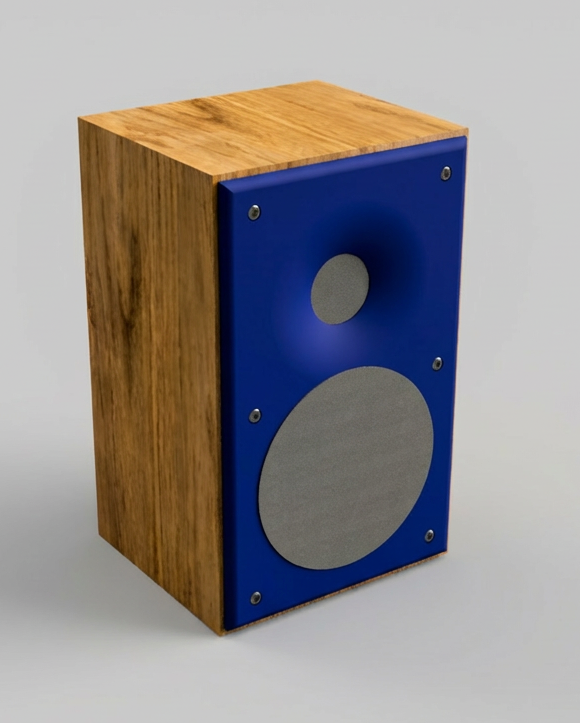
During a recent conversation with Andy Whittle, custodian of the Rogers Hi-Fi brand, the subject came up of how the venerable, iconic, and still popular, BBC LS3/5A compact monitor might perform if it were equipped with contemporary, 2026 drivers. The KEF B110 bass/mid and T27 high frequency drivers of the LS3/5A were considered to represent the state of the art in the mid 1970s when the speaker was designed (although I suspect there might be some Scandinavian driver engineers who would disagree), and while, conceptually, driver design hasn’t changed much in fifty years, the detail engineering of the best contemporary units has advanced significantly. So, as the conversation with Andy continued, speculation turned inexorably towards action and we concluded that it really would be interesting to re-engineer the LS3/5A with 2026 drivers. The only constraint we decided on was that the LS3/5A cabinet would remain constant in terms of construction and dimensions. We christened the project the LS3/5X.
Since that conversation, I’ve been sourcing the necessary components to build a prototype speaker in order to collect the acoustic data necessary for modelling some driver integration and crossover options. However, I’m rather getting ahead of myself, because the first task in the LS3/5X project was to decide upon the identity of appropriate drivers that might be considered state of the art.
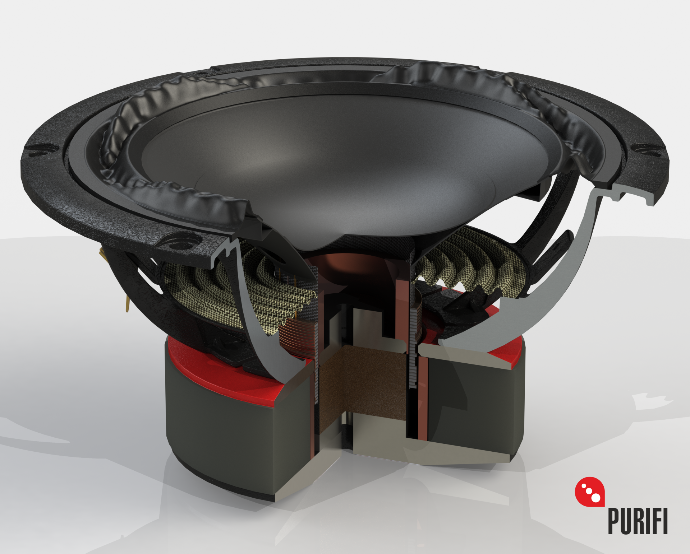
To my way of thinking, the contemporary bass/mid drivers that currently define what’s possible are made by Purifi. Purifi is the brainchild of Lars Risbo and Bruno Putzys and rather than focus on the traditional headline element of driver design; diaphragm material, Lars and Bruno turned their not inconsiderable attention instead towards the multitude of non-linear phenomena that result in distortion the instant the driver voice-coil moves. Phenomena such as surround asymmetry, inductance modulation, force factor variation and magnetic hysteresis are all minimised in Purifi drivers through a complete reapparaisal and redesign of the traditional moving-coil driver motor system and surround architecture. The result is a range of drivers that display harmonic and intermodulation distortion levels closer to those of audio amplifiers than traditionally engineered drivers. Furthermore, the benefits of the Purifi approach are particularly apparent when small bass/mid drivers are employed in compact, closed box speaker systems. So a Purifi 5 inch bass/mid driver seems a nailed-on option for the LS3/5X.
The selection of a contemporary tweeter for the LS3/5X is not so clear-cut, but after much deliberation a Danish designed and Indonesian manufactured 26mm ceramic dome driver from SB Acoustics seemed to fit the bill. The tweeter offers an unusually low fundamental resonance (690Hz) and that enables a similarly low crossover frequency (around 1.5kHz). It has a copper-capped pole piece for minimal inductance modulation, copper-clad aluminum voice-coil wire for low moving mass and reduced thermal compression, and an underhung voice-coil that helps ensure minimal excursion-induced non-linearity. One increasingly common element of contemporary tweeters however is their use in combination with a waveguide. The benefits of waveguides are twofold: firstly waveguides increase sensitivity at the lower end of the tweeter band (say, 1kHz to 5kHz), to help with that low crossover frequency, and secondly they constrain dispersion at that lower end of the tweeter band such that it more closely matches dispersion at the upper end of the bass/mids driver band. Now, at first sight, adding a waveguide to the LS3/5X might seem to be cheating. However, behind the characteristic Tygan grille of the LS3/5A can be found four strips of adhesive foam that surround the tweeter and effectively create a rudimentary waveguide. So engineering a contemporary style waveguide for the LS3/5X seems reasonably justified.
The project has progressed now beyond proving the principle with a single speaker towards building a fully representative pair, and if that is successful, the LSA3/5X could potentially become a commercial product. It won’t be inexpensive, and it would be manufactured (quite possibly by yours truly) exclusively to order in very small quantities. If you’d like to know more or are simply intrigued, please get in touch via the contact form on the About page.
 Music and Miscellany