
I happened upon a small start-up loudspeaker company called Audio First recently and was so intrigued I thought I’d write a little blog post about it. Originally from Hong Kong, Audio First founder Harry Yeung gained an MSc in Acoustic Engineering from Salford University and, following a period working in architectural acoustics back home, has been resident now in the UK for five years or so during which time he’s built a CV that includes periods working at Celestion, Monitor Audio and KEF. There’s two strands to Harry’s Audio First company. Firstly, Harry provides electro-acoustic design consultancy and measurement services. Harry is fortunate to have one of the very few Klippel NFS loudspeaker measurement sets in the UK that is not tied in-house to a manufacturer, so he is able to make the Klippel set available to speaker designers and manufacturers that are not otherwise able to access such advanced measurement technology. But what, I suspect you’re wondering, is a Klippel NFS and what does it do? Now, I began by answering those questions in the following paragraphs but I veered way too far off-piste for a blog post about Audio First, so I’m going to move that material to a second blog post all about measuring speakers. You can read that post here.
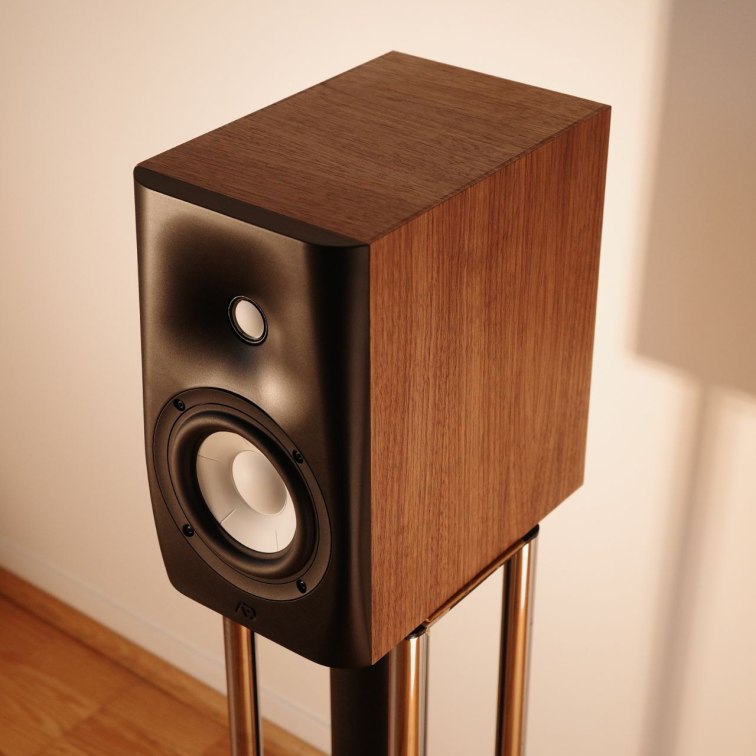
Meanwhile, back on track with Audio First, the second strand of the company is the creation of a range of high performance speakers. The first model, the Fidelia, is primarily available as a self-build ‘flat pack’ kit including CNC routed cabinet panels, but it will soon, says Harry, also be available in complete form. The Fidelia is a compact, passive two-way speaker comprising a 130mm bass/mid driver and a 25mm tweeter, both featuring aluminium/ceramic diaphragms. The bass/mid driver is reflex loaded in an approximately 9 Litre cabinet volume, while the tweeter radiates into an in-house designed waveguide routed directly into the cabinet front panel. A third order passive crossover network integrates the drivers at a pretty low 1560Hz – partly made possible by the tweeter sensitivity gain resulting from the waveguide. The Fidelia brings nothing that is particularly new to speaker design, however developing any genuinely capable speaker is as much about the details as it is about big concepts, and the Fidelia is hugely impressive in terms of getting the details right. The custom waveguide and low crossover frequency is one example, as are the comprehensive cabinet bracing and the positioning of the rear mounted reflex port so that its entrance is located at a node point inside the cabinet where internal standing wave energy is minimal. Harry has also chosen the drivers for the Fidelia well by selecting SB Acoustics units of inherently high performance that particularly show very low distortion. The Fidelia is a well thought-through, holistic design, and that’s clearly apparent in both its measured and subjective performance.
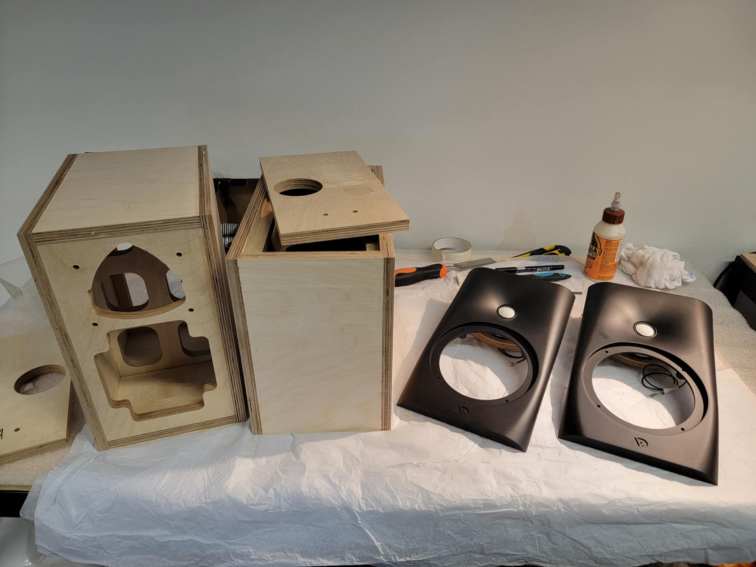
Harry was kind enough to lend me his demo pair of Fidelia and I found them to be just as capable and enjoyable as I’d hoped. Being a small loudspeaker, the Fidelia can’t hope to compete with larger products in terms of maximum SPL or low frequency bandwidth extension, but for modest volume nearfied work, it is notably well balanced, uncoloured and detailed, and offers an extremely high level of fundamental performance and sound quality. Harry is in the late stages of developing a larger, three-way speaker, to be called the Cadentia 3, and I’m very much looking forward to hearing it. If you’re intrigued by all this, you can find Audio First here.
 Music and Miscellany
One thought on “Audio First Fidelia”