

If you’ve not read the first two installments of this series of blog posts you won’t know that myself and my wife Helen had the pleasure late last year of getting to meet and interview Hans-Martin Buff in the extraordinary environment of Peter Gabriel’s Real World Studios (in Box, Wiltshire, UK). When we left Part Two, Buff was talking about the creative approach to mixing immersive music. Part Three continues in that vein, with a somewhat geeky question.
I’ve got a question here (in my notes) that just says, “beds or objects”. Are you an object man or a bed man? I’ve talked to quite a few people, engineers working in Atmos, and some say, “I don’t touch objects. I just do it all in beds”. And some say ,”oh, everything is objects”.
Off-line from the interview for a moment I’ll explain beds and objects. The Dolby Atmos format delivers audio to speaker arrays in a far more sophisticated manner than previous surround sound formats such as Dolby Surround, Dolby Pro Logic, Dolby Digital and DTS. These old formats were all channel-based in that signals were positioned simply by adjusting their relative levels in each speaker. Dolby Atmos, however, is an adaptive, “object-based” format in which mix elements, known as objects, can be positioned discretely, and dynamically panned around the entire immersive audio canvas (360° in the horizontal plane, 180° in the vertical plane), to provide both immense creative possibilities for the mix engineer, and a far more rewarding immersive experience for the listener. However, along with dynamic audio objects the Atmos format also includes a traditional channel-based layer known as a “bed” (multiple bed layers are possible). Static mix elements, that don’t require the dynamic panning of objects, can be mixed into a bed. It’s entirely up to the mix engineer how these beds and objects are employed in an Atmos mix.
When I started I was very bed oriented because I figured, you know why? Why do I need more, other than for the heights? It just gets messy. But I’ve changed my tune. You know, I work in Pro Tools, and in the beginning, I don’t know when they changed it, I think it was only two years ago that you couldn’t do bus sizes bigger than 7.1. So I had to use objects to do point four (the Atmos height channels). And one of the things I didn’t realise at first is when you route stuff in a bed to the top, I figured if it’s 7.1.2, then the point two is the two front height speakers. But it isn’t, it’s the entire left side and the entire right side. So if you pan something to the left, it’s all there and it’s going across. So you’re making a huge phantom image, which is not something you want. So what I do now is I make object beds where individual “corners” of it are objects. I’ll show you how that works, if you like.
If you’ve got time. Yeah, I’d like to see that. Now, stereo Atmos objects have become available in Pro Tools and my gut feeling is that stereo objects is a nonsense.
Not at all. I think that’s one of the first things I realised when I was working, actually, for binaural, is that we’re looking at a huge collection of stereo points. Yeah. I mean, there’s two things. These are musts as far as I’m concerned. There’s one term. It is a technical term, so I use it, “balls to the walls” (objects in the Dolby Atmos rendered software display are graphically represented by coloured balls in a listening room schematic). What people that start (with Atmos) usually do right away is they see this, these panning boxes with like a head in the middle (the room schematic), and they figure that head is mighty lonely so they put all the sounds (the balls) all around it.
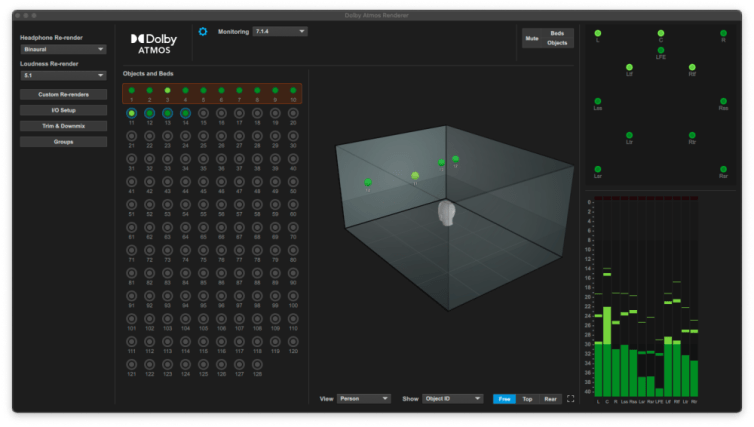
The green balls in the room schematic correspond to Atmos object positions.
And you have to realize that even in binaural it’s an approximation of a speaker setup. When you have stereo, you have two speakers, but you hear stuff out of the middle – it’s called a phantom center. Now, (in Atmos) if you put something in the middle, it’s a phantom center out of every freakin speaker you have. Meaning you will totally ruin the definition of the sound. So I never do that. “Never” well that’s not quite true. I’ll do it I want something that is really undefined. But usually all my sounds (balls) are always on the wall. Nothing is ever pulled in because if you have the definition that gives, you can really set up your sounds. So I have tons of stereo objects. I’llI create, for example, one for the back between left and right, which also in terms of mixing allows me to use my stereo tools.
The reason stereo objects feels like a nonsense to me is that stereo works by creating a phantom image based on a correlated phase relationship between the two channels. If you were to pan one side of a stereo object independently to the other, so that the phase relationship becomes uncorrelated, it’s no longer stereo. It’s two independent mono objects.
I mean, that’s fair enough. I have no opinion on that actually, whether it’s stereo or two mono objects that work together doesn’t matter to me at all. I mean, it’s cool because its a stereo object or two mono objects that happen to be addressable as a (discrete) thing. I’m actually thinking, like, why don’t you allow me to do quad objects, because I could do something up there (height channels) or whatever.
We’ve covered everything that I had but I suppose there’s one more thing: the politics of Atmos and downmixes for people with Apple Music who haven’t got Atmos switched on, who will then listen to your Inside mixes and hear a stereo downmix.
They do not. They will hear the Dark Side mix. So it’s worse than you think and better than you think. So one of the problems I think right now with the whole Atmos approach is, well there’s lots of problems, but the main one, I feel, is that you can’t just deliver an immersive mix, period. You always have to have a companion stereo mix, which means that economically, people pay more for the same thing by making an Atmos mix on top of what they deliver anyways. Apple’s now paying 10% more per stream if there’s an immersive mix but still, you know, 10%…
Of nothing is still nothing. No?
You underestimate how much money you can make with that stuff. But anyway, it’s like, this is the way I want the music to sound, it’s my artistic intent. I live with the consequences if my fans hate me for it. Where were we going with this?
I just wondered what your feelings were about how Atmos is dealt with in terms of Apple Music and other streaming platforms.That was the original question.
With the Dark Side with the stereo. That’s where we were. That’s where we were, in stereo.
I didn’t know that. I thought they’d just got a stereo downmix of the Inside mix.
No, so here’s what happens. So the better part is, I mean, like you said, that you can’t just do immersive there’s always a stereo companion piece. So if you have your (Atmos) preferences set to automatic or to off, you get the Dark Side stereo mix. You don’t get the downmix. Now if you say if you have Atmos always on and your Apple device sees okay, you have something that can’t decode Atmos, then you get a downmix. So as soon as you have your Atmos preference on and there is something that can play Atmos, even if it’s just stereo (binaural) you’ll get the downmix.
Yeah, now that is a problem but I don’t think I’ve checked it once. Yeah. The only time would be like when I was at my house and I did, like, a little update on a mix, and I don’t have the speakers, and it was about sonics, so I’d go to stereo and see if I, you know, if the vocal sound was right or whatever it was.
But two things happened. So I think the one hater comment about the mix ever that I saw was some guy, German, of course, saying, “wow, that Hans-Martin Buff. He’s clearly totally out of his depth”. He probably listened to the Atmos mix just as a downmix, and it wasn’t as huge and compressed as the other two mixes. And the other thing is that audiophiles prefer the downmix of my Atmos mixes because they’re not as compressed and not as “mastered”. But I just observe all this with a certain sense of amusement/annoyance. So, you know, all the ups and downs of all this are fairly inconsequential technically. You see, the beauty of it is we’re kind of at ground zero. So whatever we do now is the first time.
It’s like 60s music. A lot of the bands that are now revered, if I listen to them with today’s ears, I go like, huh, maybe should’ve spent a bit more time on that. But because they’re the first doing it, it’s the foundation of everything else that came down the road. And that’s where we are right now. So whatever the problem is, as long as people are open minded, they really want to promote it. We’re fine with it. And, you know the beauty about my personal position is I get to talk to people. So I get to talk to people, the distributors, the people who make the tools. And artists like Peter, and I’m sure, you know, he would have never called me for a stereo mix because he’s set up, I mean, he has cool people and he’s happy with them. They’re friends. So I get to come in here and really offer my insights on this particular thing. There will be something that we haven’t thought of right now, which came hopefully out of a musical necessity, because somebody whom we don’t know yet made an immersive mix without thinking, “oh, this is an immersive mix”. They just made a piece of music that happens to be produced in immersive, and that’s the way it should be. That’s my story. I’m sticking to it!
And that completes the Hans-Martin Buff interview. It just remains for me to offer sincere thanks to Buff and Real World for indulging (and feeding) myself and Helen. Listening to i/o in the Big Room, where it was created, really was something of a pinch-myself moment. Thanks Buff.
 Music and Miscellany