

In my last, Dolby Atmos flavoured blog post, I recommended Hans-Martin Buff’s Dolby Atmos (Apple Spatial) In-Side Mix of Peter Gabriel’s 2023 i/o album. Now, that recommendation was not merely because I think “Buff’s” i/o In-Side mix is wonderfully imaginative, emotionally involving and technically brilliant, it’s also because myself and my wife Helen had the pleasure late last year of getting to meet and interview Buff in the extraordinary environment of Peter Gabriel’s Real World Studios (in Box, Wiltshire, UK). As a fan of PG’s music since my teenage years, this was something of a ‘pinch-myself’ moment. Furthermore, a little while after this blog post began to to take form, Buff’s work on i/o was recognised with a Grammy.
Buff once described himself on his website as an, “International Soundmaster” and while that title might suggest a certain arrogance, the reality is one of easy-going self-effacement, humour and modesty. There’s not however much in Buff’s CV to be all that modest about. Beginning his career in music production at Pachyderm Studios in Minnesota, USA he proceeded to hone his studio chops by assisting on projects such as Live’s million seller “Throwing Copper”. Buff then worked his way through various Minnesota studios before finding a more permanent role for four years as Prince’s personal engineer at Paisley Park Studios. During this period, Buff wasn’t only responsible for His Purple Majesty’s recordings, but also for collaborations with artists such as No Doubt, Chaka Khan and Larry Graham. Buff relocated to his native Germany in 2001, where he has since recorded, mixed and produced a host of national and international talent, such as Mousse T., Joss Stone, Zucchero, Eric Burdon, Roachford, Maxi Priest, the Scorpions….
Since 2018, Buff has enthusiastically explored the art and practice of immersive audio and is widely considered to be one of the primary practitioners in the field. He’s currently affiliated primarily with msm-studios in Munich and Berlin and with Real World Studios, where he created the i/o album’s In-Side mix in the Red Room at the studio complex.
Our interview with Buff also took place in the Red Room. I’ve transcribed and gently edited a few sections of the interview, selected for their particular relevance to the i/o In-Side mix, however it was a long interview so rather than present the whole thing in one go I’m going to split it over probably three posts. The interview was also recorded binaurally by Helen using a Neumann KU100 “dummy” head, and in the final blog post I’ll include a link to the resulting binaural audio (again with only light touch editing) on my SoundCloud page.
I began by asking Buff about his early experiences of immersive audio….
“Well, you know, I was alway aware that you have more creative space when you have more than two windows to look through, but I was always very skeptical about the whole concept. I always tell the story of my time with Prince. We did this one show called Rave Un2 The Year 2000, and it was recorded beautifully. We had all the time, we had great video people, and then at the end, somebody said we need a 5.1 mix. So I looked up what the hell that meant, and I realised it meant we had to reopen the mix and do that again. And that just wasn’t possible in Prince world. So I went to a post-production place in Minneapolis that had a TC Electronic 5.1 reverb and I took the stereo mix and ran that through the reverb. And to this day, that’s what’s on the DVD. And here’s the point. Nobody’s ever commented about it. They’ve commented about everything else, everything that I’ve ever done with Prince. You know, good, great, horrible, amazing, whatever it is. But this, nobody. So I assume nobody heard it or nobody got it. And so I just didn’t believe that, you know, it’s ever going to happen that a wide swathe of the music listening public is going to sit in a room full of speakers, properly set up in a sweet spot to listen to the stuff. So I was very skeptical.”
And then a friend of mine about seven years ago played me some binaural versions of Beatles and Pink Floyd 5.1 mixes. And it worked. And to me, that was a game changer because I figured, well, if you can do that, then that’s really interesting. You just need a pair of headphones, a learning curve, a sense of adventure and maybe three more plugins and off you go. So I got into it and made an album just for binaural, just to check it out. And then this whole Dolby Atmos, big record companies, Apple, pact with the devil thing came up, which was very handy for my then acquired skills. So that’s how I got into it. I just like making huge music.”
Next I asked Buff about the workflow of the Peter Gabriel i/o mix. The context here is that there are three mix versions of the i/o album: the Darkside mix by Tchad Blake, the Brightside mix by Mark “Spike” Stent and Buff’s immersive In-Side mix.
“What happened was all the three of us got all the same Pro Tools session with all the final takes and a kind of a rough mix. And it progressed from there. But I don’t know what the others did. To this day, I haven’t listened to the stereo mixes and that tells you how much freedom I had. I didn’t have to listen to the stereo. One of my mantras for the immersive thing is: it’s all nice and good, but it’ll vanish just like all the other stuff if you don’t make music for it. What is the point of taking music that was made for stereo and just pointing it a different way? Because if you make music for immersive, you have to hear it as you make it. What’s the point of listening in stereo and imagining things and then going into a mix room with lots of speakers, like the one we are in now, where you really don’t do anything else and start from scratch. Peter heard my plea and said, and I quote, “I don’t care at all if it sounds anything like the stereo mixes, as long as it’s great”
“And so any material that I added to the mix was to that effect. It’s not like what was there wasn’t great, that’s not what I mean. But it was produced for stereo, over quite a long time. But the whole point of mixing is to take all the ingredients, understand the musical direction, and then, forge it into a whole that works. So if I didn’t have enough ingredients to achieve the musical peak that is clearly being offered by the piece, what am I going to do? So the first track I mixed was Panopticom. And there, the big climax or the sun rising is, you know, the pre-chorus or chorus, whatever it is, (we’re still arguing about it. Which one’s the chorus? Which one’s the pre-chorus?) Where the acoustic guitars come in? And in the session I got, there were two guitars, which is plenty for stereo. But there was no sun rising in my immersive world. So I said, can I record a bunch more guitars? And there was some hesitation. Yeah. Um, and they said, okay, do what you have to do. And so I recorded a bunch.”
More guitars that sit at the back in the mix behind you?
“They’re all around you. I recorded six more guitars. And yeah, well, I just made the sun rise. And even before, there was no restrictions on me muting stuff, and I assume that’s the same with the others. But if he (PG) doesn’t like it. He says. For example, there’s a song called ‘This Is Home’ which to me kind of felt like it was going into a Cowboy Junkie, subdued, guitar-y type direction. And all of a sudden there was this, like, super happy string part. So I muted that. And that’s the only thing he ever said. Oh no no no, that’s not going to happen. I mean he had like, details here and there, but that was the only main thing where I was reined in a bit.”
Did Peter give you notes?
“He would give me notes. But most of the time I tried to play it for him in here, and then he just let me know what he liked or didn’t like. And it was really interesting because there was only a couple of the usual mixing comments; “I’d like the snare to be brighter”, or whatever, but most of it was like, “ah, this shouldn’t be so prominent because the story is being told by this. And that’s in the way”. For example, on (the song) Playing For Time, the strings were much louder in my mix, in the beginning at least, because there isn’t much else just piano, bass, vocals, strings. And Peter said, “well, the story is, you know, you don’t hear my story enough anymore”. And he was right. But that’s the type of input I would get anyway. So after the Panopticon thing, I was just getting more and more reckless and, you know, I made doubles of things to have the size at my disposal. Musical size.”
Reckless. That’s the feeling I get listening to the In-Side mixes compared to the stereo mixes. Now, maybe that’s kind of the nature of the beast in that the stereo mixes have to be constrained between two speakers, but there’s a certain recklessness, a certain joy and expansiveness in the In-Side mixes. Now, as I said, maybe that’s because I’m listening to twelve speakers rather than two. But there is a sense, I think, in the creativity of it that it’s kind of more of everything.
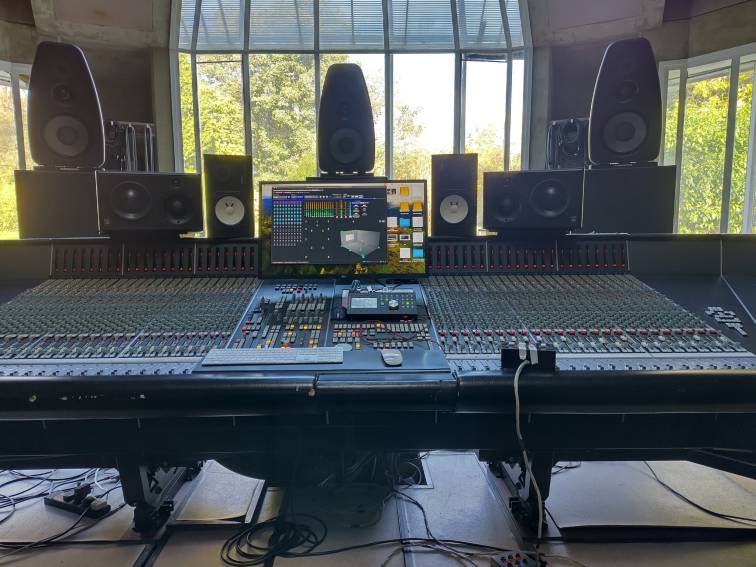
More is more. You know, I’ve done other Atmos mixes I’m very proud of, but the music is just not as conducive to what it (Atmos) can do. And clearly it’s not about me but, you know, what’s really special about Peter Gabriel is that he actually wants your contribution. Not, you know, like working with Prince. My brief there was clearly I do the stuff that he can’t do himself. I keep his machine going. I’m oiling his machine. With Peter, it’s like. So, what’s for dinner?
And that concludes Part One of the Hans-Martin Buff interview. I’d you’d like a notification of the publication of Part Two, the best way is to sign-up to follow the blog.
 Music and Miscellany
One thought on “The Hans-Martin Buff Interview – Part One”