
If you have any interest in contemporary music and its production, which, bearing in mind you’re reading this, I think it’s a fair assumption that you do, you’ve probably seen or heard the words Dolby and Atmos quite regularly in recent years. Quite possibly you’ll already be familiar with pretty much everything I’m about to write in the next paragraph, in which case my apologies, however a quick recap on the basics of Atmos feels appropriate before I get into the guts of this post.
Dolby Atmos is an immersive audio technology that aims to put a listener at the focus of a three dimensional sound field that extends 360 degrees in the horizontal plane and 180 degrees in the vertical plane. Within that hemisphere, the apparent source of sounds (“objects” in Dolby Atmos-speak) can be placed at will and moved dynamically. Dolby Atmos was developed primarily with audio visual experiences in mind, namely movies, but it is also very well suited to domestic audio, be it music or home cinema, for a couple of really important reasons. Firstly, while full-fat Atmos demands an audio system that provides 16 separate output channels and speakers, when Atmos material is played through a system that comprises fewer channels and speakers, its playback protocols automatically downmix the material appropriately. No content is lost, it’s just reproduced with less positional accuracy. This works all the way down to stereo. Secondly, Atmos downmix protocols include one that creates binaural stereo, and that offers over headphones a very fair rendition of Atmos immersive qualities. In fact, Apple Spatial, found in Apple Music streaming, is fundamentally a binaural downmix of Dolby Atmos. This ability of the Atmos format to downmix to suit the playback architecture, especially binaural, is predominantly I think the reason for its success. If you happen to be an Apple Music user and haven’t yet experienced Apple Spatial over headphones I urge you to make sure Atmos is switched on in your Music app settings and that you investigate a few Atmos releases. For an initial recommendation, search for the Inside Mix of Peter Gabriel’s i/O album created by Hans-Martin Buff (there’ll be more about “Buff” in a future blog post).
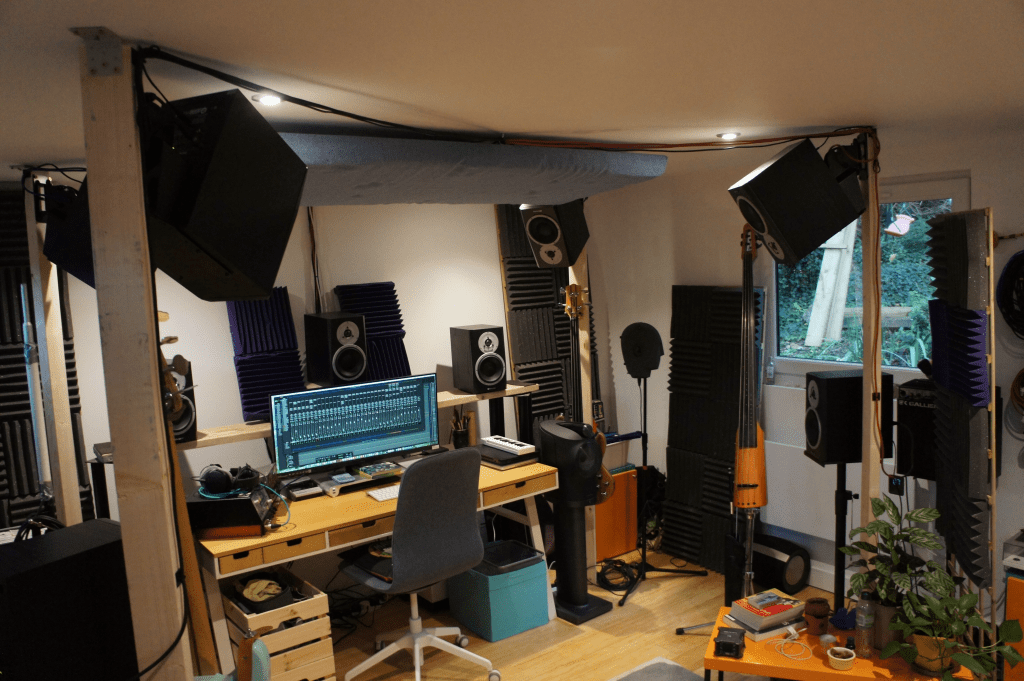
Now, I’m writing about Dolby Atmos (alternative immersive audio technologies are of course available) partly because, as part of my work contributing to Sound On Sound magazine, I’ve begun to write about products aimed at Atmos mix work. This has partly been made possible thanks to a loan by Dynaudio of nine BM5 MkIII monitors and an 18S subwoofer which, as shown in the picture, are installed in my studio to create a 5.1.4 monitoring system (the subwoofer is under the desk). And actually, since the photograph was taken, the system has grown to 7.1.4 thanks to the arrival of a 16 output Audient ORIA interface and a further pair of BM5 MkIIIs found on a well known auction site at a bargain price.
Having an Atmos monitoring system and reviewing products aimed at Atmos mix work also means that I’ve had to research and learn about Atmos mix techniques and workflows (using Pro Tools and the Dolby Atmos Renderer application), and that’s been a truly fascinating and rewarding thing to do. I’ve gone from mild Atmos skepticism to near evangelical enthusiasm for all things immersive in audio (helped by my wife Helen’s expertise and creativity in the world of immersive theatrical sound design). Mixing music for Dolby Atmos changes everything. All the conventions around the architecture of stereo are no longer relevant because the stage on which a mix plays-out is hugely bigger. This means not only that there is immeasurably more opportunity for creativity in terms of how mix elements are positioned and move, there is also far less requirement to shoe-horn mix elements into a restricted space by radically profiling their tonal balance. In a conventional stereo mix it’s often necessary to curtail the tonal bandwidth or bend the tonal profile of an element so that it doesn’t tread on the toes of those with a similar character. In an Atmos mix however, elements that might conflict tonally can be moved apart either laterally or vertically, and that freedom can radically change the approach to mixing music.
Back to my Sound On Sound contributions, I’ve so far had three reviews published of products specifically designed for Amos work: the Audient ORIA, the Fiedler Dolby Atmos Composer, and Sonarworks Sound ID Reference for Multichannel and there’s more on the way.
I’ve also been developing my own Atmos mix skills and I’ve recently added a binaural downmix of an Atmos track to my SoundCloud page. This is a mix of a February 2024 live performance by Paul Diello’s Epicene band of Portishead’s ‘Glory Box’. The band is Paul Diello on vocals, Will Nash on sax, Ben Jones on piano, Francesco Bonini on guitar, Andy Fraser on cajon and myself on electric upright bass. The track was recorded live by Tom Ayres. Click here or on the picture for the link and LISTEN ON HEAPHONES!

 Music and Miscellany
Just listening… crappy Apple pods on my Mac. That is truly astounding!! You’ve sold me…
LikeLiked by 1 person